Key Takeaways
|
Have you ever looked at your ancestry results and wondered, “Where did this Scottish ancestry come from, my mom’s side or my dad’s?” If you’re one of the millions of 23andMe members who haven’t connected with a parent who has tested with us, that question has been sitting unanswered.
That changes today.
We’re launching Premium Parental Inheritance, a feature that shows you which side of your family each ancestry region in your results came from regardless of whether or not a parent has ever taken a 23andMe test. Powering this expansion is a DNA analysis we call Family Phasing, a method that uses your existing DNA relatives to determine which side of your family your ancestry comes from. The feature is now available to all 23andMe Premium members.
Your Ancestry Has Two Sides. Now You Can See Them.
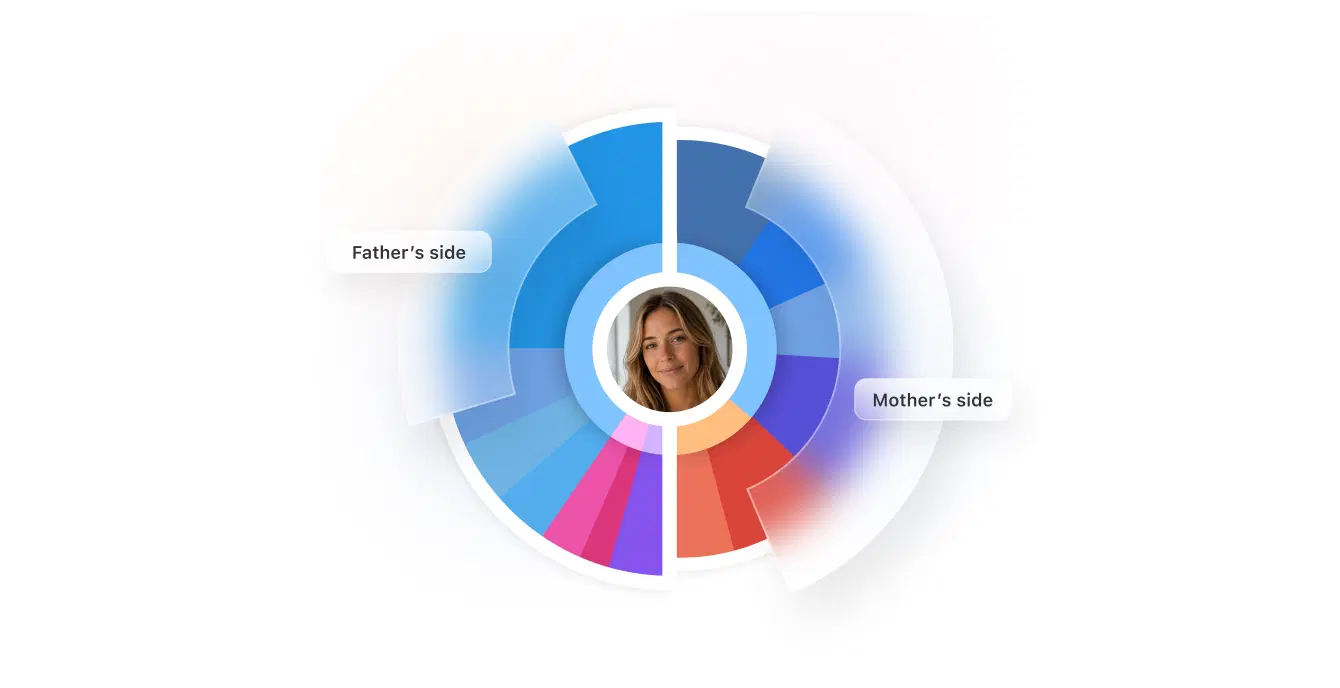
Parental Inheritance has long let customers see their Ancestry Composition split by parent: how much of your Andalusian, Asturian & Castilian ancestry came from one side, how much of your Nigerian ancestry came from the other. For people who had it, the reaction was often an “aha” moment. Suddenly your results became a story about blending two distinct family histories.
But accessing it required connecting with a biological parent in the 23andMe database. If your parents had passed away, were unknown to you, or simply weren’t interested in testing, Parental Inheritance wasn’t available to you. That left many without a way to access a feature that helps answer so many questions.
Family Phasing changes that for many people who have enough relatives in the dataset. Using these relatives, we can often confidently determine parental inheritance for large sections of your DNA.
If you’re a 23andMe Premium member, you’ll now see your Ancestry Composition results split into Parent 1 and Parent 2 — showing how much of each ancestry region you inherited from each side.
Some people won’t immediately know which labels map to their maternal or paternal sides. You can use your ancestry percentages as clues. If Parent 1 shows a high percentage of Irish ancestry and you know that Irish ancestry runs on your dad’s side, you can rename Parent 1 to “Paternal Side.” But if one of your parents has tested with 23andMe and is participating in DNA Relatives, you’ll see them connected to their corresponding side.
The Science: How Family Phasing Works
To understand what’s new, it helps to understand how Parental Inheritance worked before.
Your 23 chromosomes come in pairs: one chromosome in each pair comes from your mother, the other from your father. Figuring out which genetic information came from which parent is called phasing. Previously, 23andMe could perform a high-quality phasing by directly comparing your DNA to a connected biological parent’s.
Without a connected parent, we relied on statistical, population-based phasing. These population-based phasing methods are typically good at determining which variant came from which parent over a short region of your genome. However, they fall short when trying to piece these short, well-phased regions together. As a result, they might phase your genome one way at one end of a chromosome, and the other way at the other end.
Family Phasing solves this for portions of your genome by looking at the DNA relatives, even distant ones, you already have in the 23andMe database. The key insight: if you and a relative share a segment of DNA, and that relative is on your mother’s side, that shared segment probably came from your mother. Family Phasing uses these shared DNA segments across many of your relatives to build a confident picture of which portions of your ancestry came from each parent, no connected parent required.

The more relatives you have in the database, and the more closely related to you they are, the more confidently we can determine which side each portion of your DNA came from. Your results include a general view that assigns every ancestry region to a parental side, plus a view of stricter confidence levels, where any lower confidence regions may show as inconclusive.
Your Upgraded Path to Parental Inheritance
Thanks to our new Family Phasing technology, Parental Inheritance is getting a major upgrade and moving to 23andMe Premium. If your parents have never tested with 23andMe, this is what you’ve been waiting for. Premium members without parents connected can now explore their parental inheritance for the first time.
If you’re a 23andMe Premium member and you previously had Parental Inheritance through a connected parent, your experience is evolving. The underlying science is now powered by Family Phasing.
If you’re not already a 23andMe Premium member, your previous Parental Inheritance is no longer available. However, if you upgrade to a 23andMe Premium membership, your results will begin computing automatically, and you’ll receive a notification when your report is ready.
What’s Coming Next
Parental Inheritance is more than a single feature — it’s a lens that can be applied across your entire genetic story. We’re exploring how to bring the same Parent 1 / Parent 2 view to other parts of your 23andMe experience, so you can understand not just what your DNA says, but which side of your family it came from.
Your ancestry has always had two sides to it. Ready to see both? If you’re not currently a 23andMe Premium member, but interested in this feature, check out the 23andMe Premium membership to unlock Premium Parental Inheritance and find out which side of your family shaped the ancestry you carry.
Premium Parental Inheritance is available to 23andMe Premium subscribers in the US, Canada and UK. Results depend on the number and relatedness of your DNA relatives in our database. All users will receive a full partition of their ancestries into parental sides. However, users with more relative matches will typically receive more confident parental ancestry assignments.