Key Takeaways
|
What do a 5,000-year-old iceman, a famous composer and a Mayan sacrifice victim have in common? They are all part of a growing collection of more than 1,000 people from the past whose DNA you can compare with your own through 23andMe’s Historical Matches feature.
When we launched Historical Matches in March 2024, it included 335 historical individuals from around the world. Earlier this month we added the 1,000th. To mark the milestone, we’re explaining the science behind each match, looking back at how the feature has grown and sharing what we’ve learned from the first 1,000+ historical individuals.
How Does Historical Matches Work?
Historical Matches compares your DNA to genomes sequenced from ancient and historical remains and looks for identical stretches of DNA you share with each person. Scientists recover this DNA from bones and teeth found at archaeological sites and, in rare cases, from other sources. Beethoven’s genome, for example, came from authenticated locks of his hair. Researchers publish these genomes in peer-reviewed studies, and 23andMe uses that publicly available data to build the feature.
To find a match, 23andMe scientists search for segments of DNA that are identical by descent, or IBD. An IBD segment is a piece of DNA that two people both inherited from the same ancestor. It’s the same approach that powers our DNA Relatives feature. In order to ensure that matches are real, and not false positives, a shared segment has to meet a minimum length. This minimum segment length we use depends on the quality of the genome we have for each historical individual, but it typically ranges from 3-10 cM.
Getting a Historical Match typically doesn’t mean you descend directly from that person. It means you and the historical individual likely share a common ancestor, someone who may have lived long before either of you. Most matches reflect very distant connections, though some may be closer.
Not every historical figure can be included. Ancient DNA breaks down into short fragments over time, and only some remains yield enough high-quality, genome-wide data to work with. That’s why the feature can include Beethoven but not Mozart or Bach. Even Richard III, whose remains were identified in 2012, isn’t included because researchers sequenced only his mitochondrial DNA and parts of his Y chromosome, not his full genome.
How Has Historical Matches Grown Since 2024?
Historical Matches launched with just over 300 individuals from only 10 groups such as the Viking Age, Iron Age Taiwan, the First Peoples of the Caribbean and the ancient city of Beirut.
Since then we’ve updated the feature regularly, adding people from new places and time periods. Additions have included Ancient Romans and Medieval Avars, Neolithic Ireland, Colonial Mexico, young boys who were ritually sacrificed during the Maya civilization, the Sarmatians of the Eurasian steppe and the Shaman of Bad Dürrenberg, a woman buried in what is now central Germany about 9,000 years ago.
1,000 Historical Matches: What We’ve Learned So Far
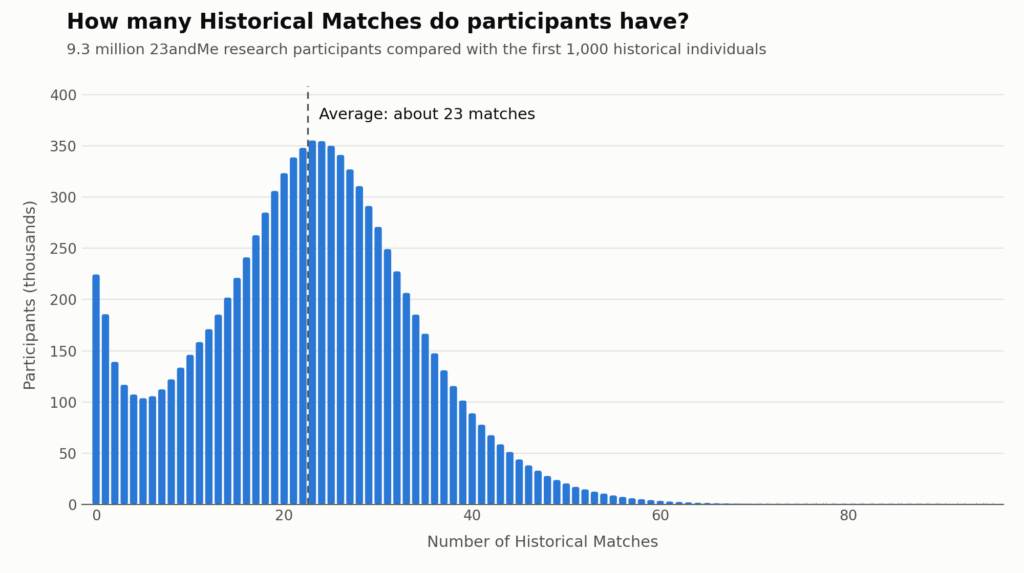
With more than 1,000 historical individuals now in the feature, we thought you might be curious about how common Historical Matches actually are. Here’s what we found in an analysis comparing the first 1,000 historical individuals added to Historical Matches with the DNA of more than 9.3 million consented 23andMe research participants who were genotyped on our v5 genotyping chip.
Among these participants, 97.6% share DNA with at least one historical individual, and most have more than just one or two Historical Matches. The average participant matches about 23 historical individuals, and more than 60% match 20 or more.
Which historical individuals do participants match most often? So far, the single most widely matched historical individual in the feature is King Béla II of Hungary, a 12th-century member of the Árpád Dynasty known as Béla “the Blind.” He shares DNA with nearly one in four participants (23.3%). For comparison, the typical historical individual in the feature shares DNA with about 1.4% of participants, or roughly 125,000 people. Viking Age individuals also rank among the most widely matched, making up most of the top ten.
Most Historical Matches reflect very distant connections, pointing to a common ancestor who may have lived hundreds or even thousands of years ago. But for some historical individuals in the feature, we can also identify matches who share enough DNA to suggest a common ancestor in the more recent past. In our relationship predictions we label these matches as “significantly related” as opposed to the “very distantly related” prediction that most people see. These matches are genuinely rare: among the more than 9.3 million participants, we’ve identified only about 9,100 significant matches, or roughly 1 significant match for every 1,000 participants. If you’re one of the lucky few with a significant match, we’d love to hear your story at https://www.23andme.org/shop/stories/.
At the other end of the spectrum, nine historical individuals included in the feature don’t yet match anyone in our database. They include Late Stone Age South African bab001, Iron Age Taiwanese Individual I3611 and Pre-Contact Period Remote Oceanian I4451, from what is now the Pacific island nation of Vanuatu.
So why does a medieval king match millions of people, while others match no one at all? A historical individual’s match rate is shaped by several factors:
- The quality of their genome. Ancient DNA breaks down over time, and the amount and quality of DNA recovered varies widely from one individual to the next. With a higher-quality genome, we can confidently detect shorter shared segments of DNA. Because shorter segments reflect more distant relationships, a higher-quality genome lets us identify connections reaching further back in time, and those more distant connections are shared by many more people.
- Their own ancestry. Some historical individuals belonged to populations that contributed broadly to the ancestry of people living today. Others belonged to communities whose descendants are fewer in number, or whose ancestry has since mixed with other populations.
- The ancestry of our members. Most 23andMe members have European ancestry, so historical individuals from Europe tend to have more matches than those from other parts of the world. Low match rates for some regions reflect who has taken part in 23andMe research so far, not the importance of these historical individuals or the legacies they left behind.
What Research Has 23andMe Contributed to Historical DNA?
Our team has also helped lead research in this field, connecting the genomes of historical individuals to people living today. In 2023, we worked with researchers at Harvard and the Smithsonian to analyze DNA from 27 enslaved and free African Americans who labored at Maryland’s Catoctin Furnace soon after the founding of the United States. By comparing their genomes with those of consented 23andMe research participants, we identified more than 42,000 of their living relatives.
In 2026, the team studied 49 colonists buried in St. Mary’s City, Maryland’s first capital, founded in 1634. More than 1.3 million consented 23andMe research participants share DNA with one or more of these individuals, enabling us to identify Maryland’s second governor, Thomas Greene, among those buried at the site. Individuals from both studies are part of the Historical Matches feature, so you can see whether you share DNA with them too.
Why Does Every New Genome Matter?
Each historical individual in the feature represents years of work by archaeologists, geneticists and the communities connected to these sites. As researchers continue to sequence and publish new ancient genomes, we plan to keep growing Historical Matches. While most of the matches we report are distant, we hope they remind you that we are all connected to the past, sometimes in unexpected ways. The first 1,000 individuals are just the beginning. 23andMe Premium members can explore whether they share a genetic connection with any of the more than 1,000 historical individuals in Historical Matches. Not a member yet? Learn more about 23andMe Premium.