Understanding the Genetic Testing Landscape
Welcome!
In a previous module, we explored how genetics influences health—from monogenic conditions, where a variant in a single gene can have a large effect, to complex conditions influenced by many genetic variants, lifestyle, and the environment.
In this module, we'll focus on genetic testing for monogenic conditions: why people get tested, the different ways testing can happen, and how the design of a test affects what genetic information it can identify.
In an upcoming module, we'll return to complex conditions and explore polygenic risk scores, including how genetic testing is used to calculate them.
If some of the genetics terminology feels unfamiliar, you may want to revisit Module 1 for a quick refresher.
Not All Genetic Tests Are the Same
Genetic testing can mean different things in different situations, so it can be hard to know where to start. In this module, we'll use three questions to help make sense of how genetic testing works.
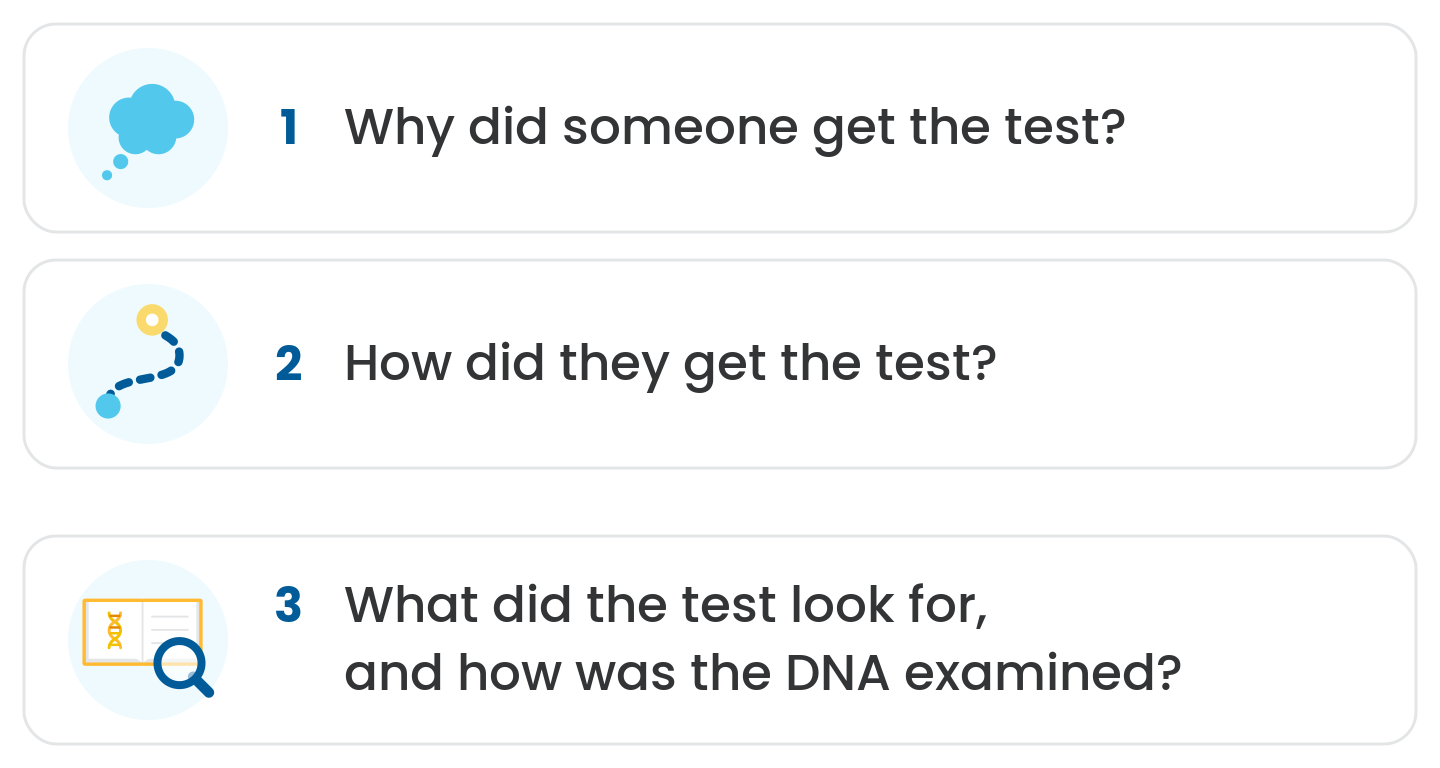
We'll explore these questions through examples of people getting genetic testing in different ways. We'll also look at the different ways genetic tests can examine DNA and why different tests can provide different kinds of information.
By the end, you'll have a better understanding of the questions to ask about a genetic test and why the answers matter when interpreting its results.
Ways to Access Genetic Testing
Genetic testing can happen in different ways and for different reasons. Here’s a quick introduction to four ways someone might get genetic testing.

Clinical genetic testing is typically ordered by a healthcare professional to help answer a specific question about a person’s health or care.
Learn more: When might you encounter this?
- Why does kidney disease run in my family?
- Why did my brother get colon cancer at a young age?
- Is there a genetic reason for my chronic, unexplained symptoms?

Population genetic screening is offered to groups of people whether or not they have a specific medical reason for testing.
Learn more: When might you encounter this?
- As a doctor, which of my patients might benefit from earlier breast cancer screening?
- Am I a carrier of cystic fibrosis?
- Do I have a genetic variant that increases my risk for a health condition, even though I have no symptoms?

Consumer genetic testing is available directly to people who are curious to learn more about their genetics.
Learn more: When might you encounter this?
- Can exploring my genetic ancestry help me better understand my family roots and identity?
- What might my DNA tell me about my chances of developing Alzheimer’s disease later in life?
- I am adopted and want to look for my biological relatives.

Research genetic testing is offered to people participating in a research study to help scientists learn more about genetics, health, or disease.
Learn more: When might you encounter this?
- Are there specific variants that contribute to lung cancer risk?
- How does genetic variation differ among people with different ancestries?
- How might genetic differences influence how people respond to cancer treatments?
Sort These Situations
Before we dig in, let’s start with your first impressions. Trying a few examples now can help you see what you already understand and where you may want to focus more effort.
Below are six genetic testing scenarios. For each one, choose what you think best describes how the person got the test.
Don't worry about getting everything right. Go with your first instinct.
Tomas has had unexplained symptoms for a while. His doctor thinks a genetic condition might explain them, and orders a genetic test to help find out.

Scenario 2: Lena
Lena read an article about genetics and got curious. She ordered a test online, sent off a sample, and got her results a few weeks later.

Scenario 3: Marcus
Marcus’s health system offers pharmacogenomic testing to all adult patients. Pharmacogenomic testing looks for genetic differences that can affect how someone responds to certain medications. At a routine appointment, his doctor tells him about the program and he decides to participate.

Scenario 4: Priya
Priya joins a study looking at how certain genetic differences relate to sleep. She gives a sample so researchers can include her data in what they’re studying.

Transition to more complex scenarios
It’s important to recognize that these four ways of getting genetic testing aren't mutually exclusive. Instead, more than one can apply to the same situation.

Think about having your blood pressure checked. Your doctor might check it because of a specific concern. You might buy a cuff and check it yourself. You might join a research study that collects blood pressure readings. Or your pharmacy might offer a free check to every adult customer as part of a heart health campaign, which is a screening program.
Sometimes the same activity can serve more than one purpose. For example, a research study might provide blood pressure screening to adult pharmacy customers to examine whether people identified with high blood pressure go on to seek follow-up care. The blood pressure check is both population screening and part of a research study.

Scenario 5: Adaeze
Adaeze joins a large study that offers genetic testing to adults who don’t have any particular medical reason for testing. Part of the study is looking at whether offering genetic testing this way is useful.

Scenario 6: Dara
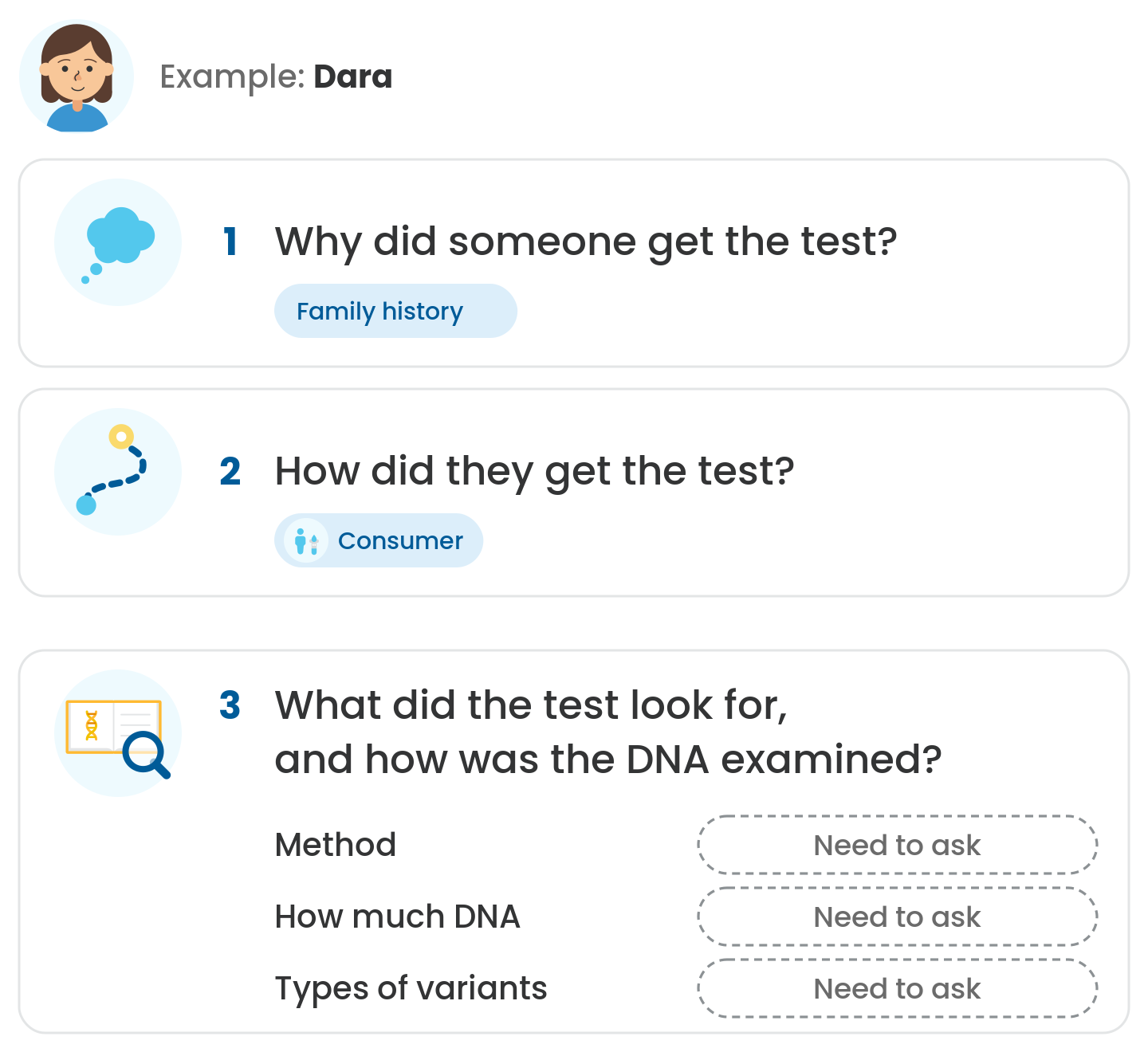
Dara's mother was diagnosed with breast cancer in her forties. Dara's doctor recommends genetic testing because of her family history, but Dara learns that her insurance won't cover the test.
Dara finds a less expensive consumer genetic test that includes some cancer-related genetic information and decides to purchase it. She plans to discuss the results with her doctor.

Three Important Questions About Genetic Testing
The examples you've just explored show that understanding genetic testing starts with two important questions.
1. Why did someone get the test?
Was there a specific health concern, family history, or medical question? Was the person curious about their health or ancestry? Or was testing offered more broadly?
2. How did they get the test?
Was it through a healthcare professional, offered as part of a screening program, requested directly as a consumer, or offered through a research study?
Tomas, Lena, Marcus, Priya, Adaeze, and Dara illustrate why these two questions matter. People may have different reasons for getting genetic testing, and more than one way of getting tested can apply to the same situation.
But there's another important question. Even when two people get genetic testing in similar ways, their tests may examine very different genetic information.
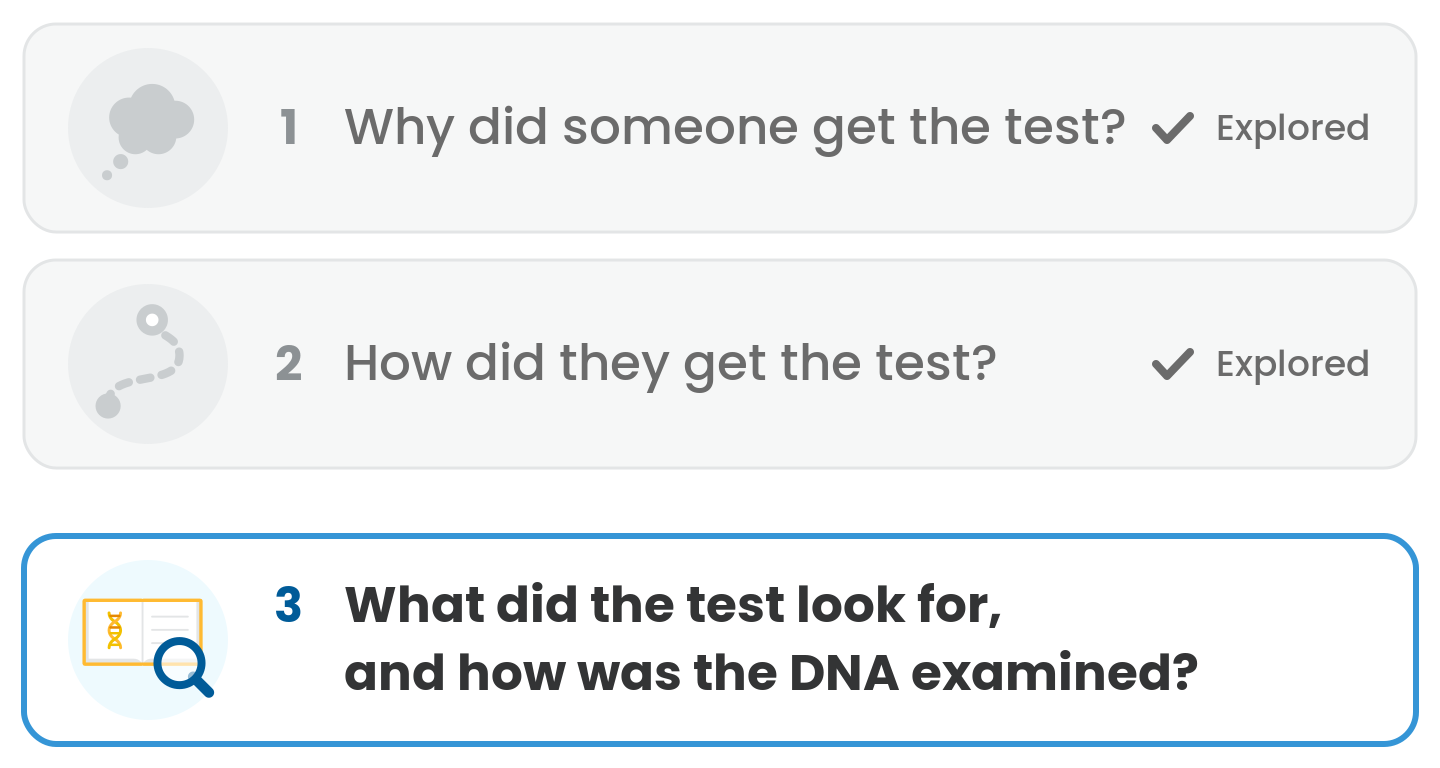
3. What did the test look for, and how was the DNA examined?
This question is especially important because it helps you understand what information a genetic test can—and cannot—provide.
What Did the Test Actually Examine?
Some tests look for particular genetic variants, while others look across entire genes, groups of genes, or nearly the whole genome. Tests also use different methods to analyze DNA.
Together, these choices help determine what genetic information a test can identify, and what its results can tell you.
How DNA Is Analyzed
Let’s start with two common methods for analyzing DNA: genotyping and sequencing.
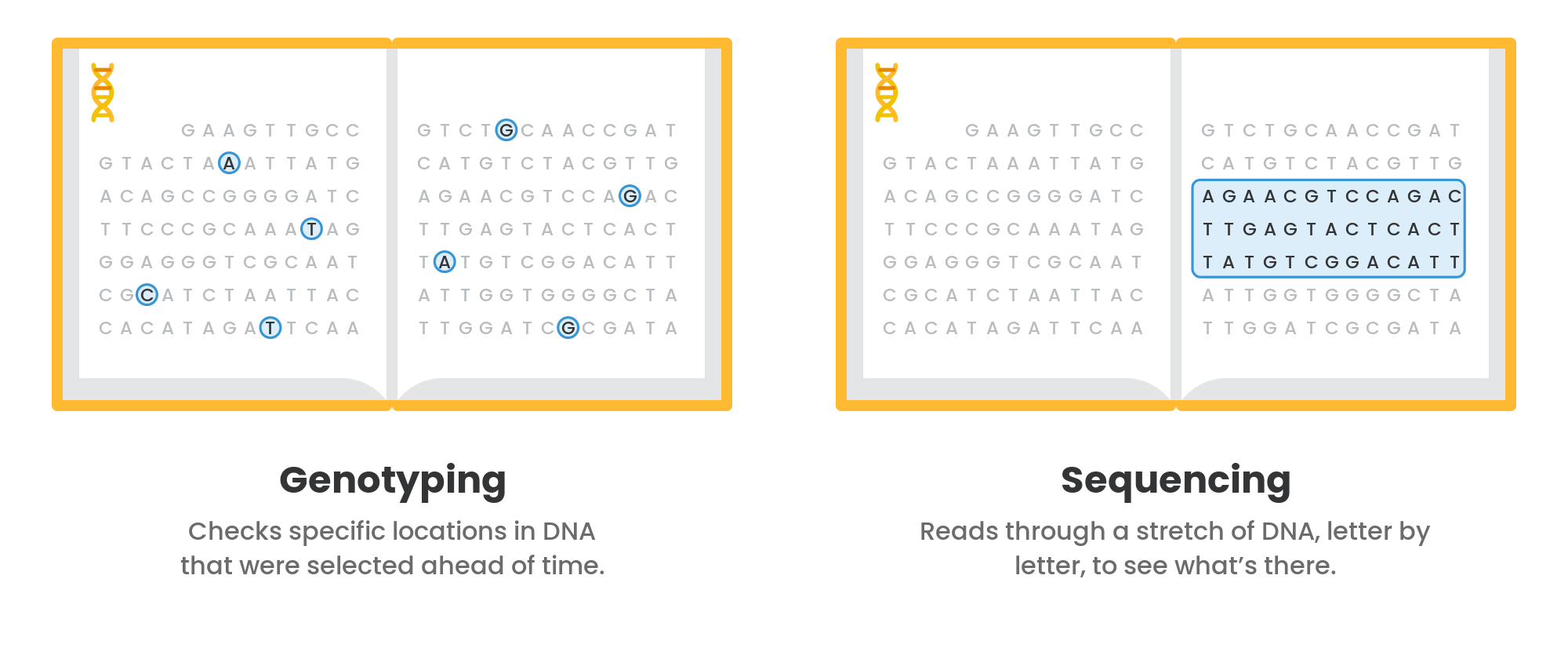
- Genotyping checks specific locations in DNA that were selected ahead of time, looking for particular genetic variants, such as single nucleotide polymorphisms (SNPs).
- Sequencing reads through a stretch of DNA letter by letter, allowing it to identify SNPs and other variants that weren’t necessarily selected ahead of time.
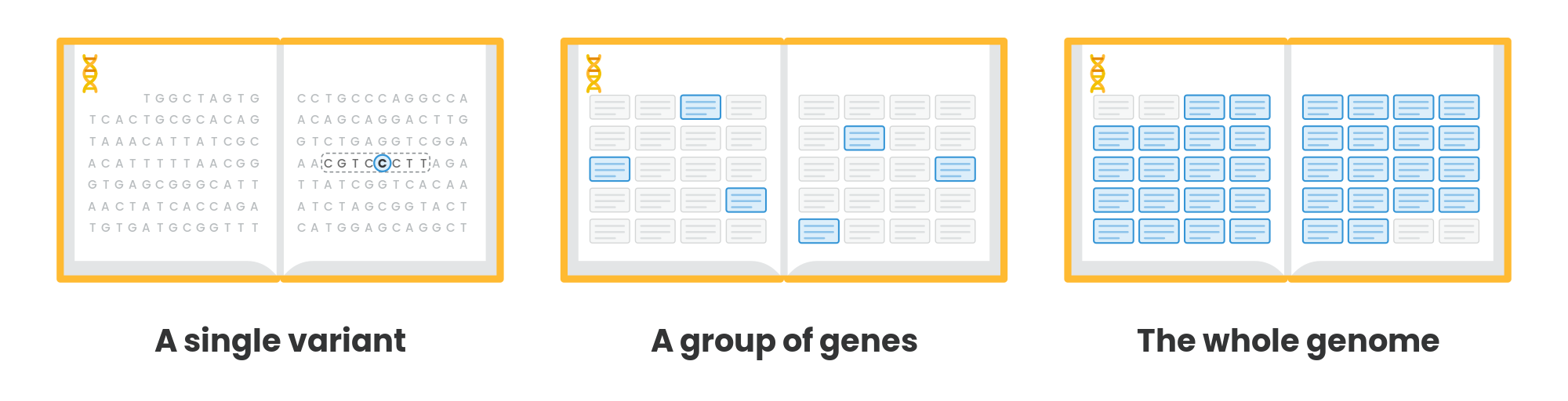
Imagine that your DNA is an enormous book.
Genotyping is a little like using a specialized spell-checker that looks only at specific places where spelling differences are already known to occur.
Sequencing is more like reading the text letter by letter. It can identify differences that weren't necessarily known about in advance.
But there’s another important distinction: knowing whether a test used genotyping or sequencing doesn’t tell you how much of the book (or genome) the test covers. A test might look for a single variant in a small section of DNA, or it may look at several genes, or nearly the entire genome. How much DNA a test looks at depends on what the test was designed to do.
What This Can Look Like
Here are a few examples that show why a test might look at different amounts of DNA.
A single known variant
If a particular genetic variant has already been identified in someone’s family, their healthcare professional may order a test that looks specifically for that variant. Finding out whether they have that variant answers the medical question, so there may not be a need to look at any more DNA.
A group of genes
Other tests look at a group of genes associated with a particular health concern, such as hereditary cancer or heart conditions. These are called gene panels. Gene panels typically use sequencing to examine the genes included in the panel. A panel might be used for population screening, or when someone has a personal or family history that suggests a genetic cause but the specific variant isn’t known.
Panels can also look for genetic variants related to reproductive health or how the body responds to medications.
The whole genome
In another situation, a child with an unexplained medical condition might have whole-genome sequencing. This may be used when it isn’t clear which genes or variants to look for, especially if the condition is rare. Looking across the entire genome increases the chances of finding a genetic cause.
Think back to our book analogy. Looking at different amounts of DNA can be pictured as looking at one specific place, selected parts of the book, or the entire book.
Different Tests Detect Different Types of Genetic Variants
How much DNA a test looks at isn't the whole story. The method used also affects the types of genetic variants a test can detect.
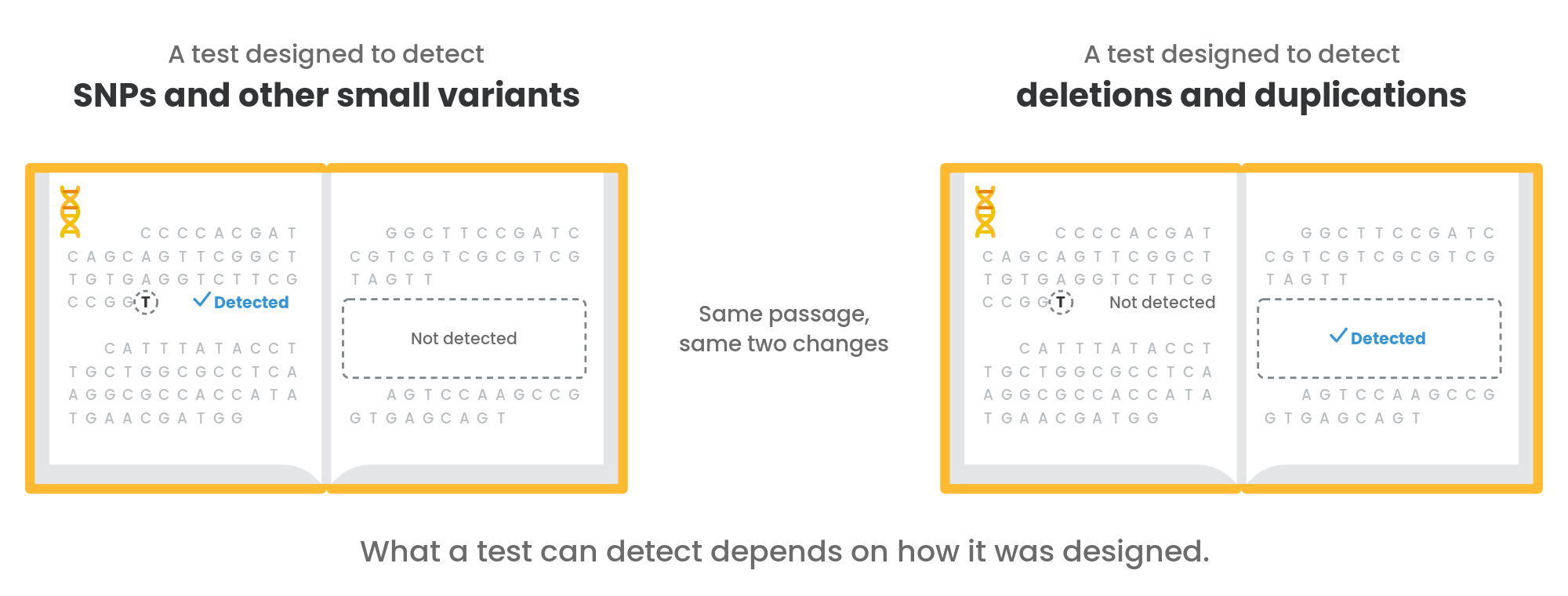
Genotyping and sequencing are commonly used to detect SNPs and other small variants. Other methods, such as chromosome microarrays, are designed to detect larger deletions and duplications. What a test can detect depends on how it was designed. Some focus on particular types of variants, while others can detect multiple types.
Returning to our book analogy, different methods can be designed to detect different kinds of changes in the text.
No Genetic Test Can Tell Us Everything
Genetic tests are designed to answer particular questions. What a test can identify depends on how the DNA is analyzed, how much DNA is looked at, and the types of genetic variants the test is designed to detect and report. No single genetic test can identify every possible genetic variant.
A “negative” result doesn't rule out genetic risk.
A genetic test result is often called “negative” when the test doesn't identify a genetic variant associated with the condition being evaluated. But that doesn't mean there isn't one. What a “negative” result means depends on what the test was designed to examine and detect.
For example, a hereditary cancer panel might examine a group of genes known to be associated with increased cancer risk, such as BRCA1 and BRCA2. If nothing is identified, that doesn't rule out a genetic cause. A variant could be in a gene the test didn't examine or be a type of variant the test wasn't designed to detect.

Genetic testing is only part of the picture.
The genetic tests we've focused on in this module are most relevant to monogenic conditions, where a variant in a single gene can have a large effect on health. But genetics can contribute to health and disease in other ways, and environmental and lifestyle factors can also play a role.
We'll explore genetic testing for complex conditions in an upcoming module.
Our understanding of genetics is still growing.
Researchers have identified many genetic variants associated with health and disease, but there is still much to learn. Historically, genetic research has involved people of European ancestry, while people with other ancestral backgrounds have been less well represented. As a result, we may know less about what certain genetic variants mean for people from those backgrounds.
Understanding what a test can and can't tell you is important when interpreting genetic test results, which we'll explore in the next module.
Bringing It All Together
Think back to the three important questions we introduced at the beginning of this module:
- Why did someone get the test?
- How did they get the test?
- What did the test look for, and how was the DNA examined?
The first two questions help you understand the circumstances surrounding genetic testing. The third helps you understand what genetic information a particular test was designed to identify.
Knowing that someone received clinical, population screening, consumer, or research genetic testing doesn't tell you whether genotyping or sequencing was used, which parts of DNA were examined, or which types of genetic variation the test could detect. Those details depend on the particular test.
All three questions matter because what a test is designed to identify shapes what its results can tell you.
Have questions about a genetic test?
Use our downloadable guide to help you ask three important questions about a genetic test: why someone got the test, how they got it, and what types of genetic variants it was designed to identify.
Check Your Understanding: Question 1A
Question 1A
Maya’s sister was diagnosed with breast cancer at age 38 and was found to have a harmful BRCA1 variant. Maya participated in a genetic screening program offered to all adult patients through her healthcare system. Her result was “negative”.
Check Your Understanding: Question 1B
Question 1B
Check Your Understanding: Question 2
Question 2
A child with an unexplained medical condition has whole-genome sequencing. No genetic cause is identified. The child’s parents assume this means the condition cannot have a genetic cause because the test looked across the whole genome.
Nice Work!
You’ve now explored several ways genetic testing can differ: why testing is done, how someone gets the test, how the DNA is analyzed, how much DNA is examined, and what types of genetic variants the test can detect.
The big idea: Not all genetic tests provide the same information. Understanding what a test was designed to identify helps you understand what its results can and can’t tell you.
Up next, we’ll take a closer look at genetic test results themselves: what different types of results mean and what they don’t.
Share Your Feedback
We’d love your feedback. This brief, anonymous survey asks about your experience with the module and how well it supported your learning. Your responses help us improve future modules.