

By Anne Greb, M.S., CGC, and Noura Abul-Husn, M.D., Ph.D.
Key Takeaways
|
Genetics is no longer just for specialists. Today, DNA insights help guide cancer screenings, flag inherited health risks and tailor medication choices. As more people learn about their DNA, including through at-home tests, a practical question follows: who helps you make sense of your genetic test results?
Our new paper in Trends in Genetics shares what we learned from building and running a genetics training program for primary care doctors and nurse practitioners, and what it takes to prepare them for this role.
Why Are Primary Care Doctors Taking On Genetics?
Genetics is quickly becoming part of routine medicine. Polygenic risk scores, which combine the small effects of many genetic variants, are starting to help evaluate risk for common conditions like coronary artery disease. At the same time, more people are bringing at-home DNA test results to their annual checkups, looking to discuss what their genetic data means for their day-to-day health.
The U.S. does not have enough medical geneticists and genetic counselors to meet growing demand. Distance, cost and logistics make access especially hard in rural and underserved communities. Relying solely on specialist referrals is not sustainable. Equipping primary care professionals to handle routine genetic questions allows specialists to focus their expertise on high-complexity cases.
How Did We Prepare Primary Care Professionals to Use Genetics?
Effective genetics training for primary care should focus on the tasks healthcare professionals perform with patients, not on turning them into specialists. Our team developed a 20-hour training program for 42 healthcare professionals (10 physicians and 32 nurse practitioners) at a nationwide U.S. telehealth medical group that cares for patients with direct-to-consumer genetic test results.
Our first step in developing this program was defining what genetics care should actually look like in primary care. We identified the specific tasks primary care professionals would need to perform and incorporated these into the training. The five skills we identified included:
- Assessing family health history
- Interpreting genetic test results in a clinical context
- Communicating risk and uncertainty
- Making appropriate management decisions
- Recognizing when to consult or refer to a genetics specialist
Learning by doing was central to the program. We combined self-paced learning with small-group sessions designed to encourage discussion. Case discussions focused on clinical situations relevant to primary care. The healthcare professional participants also analyzed personal or sample genetic data and completed a practice visit with a simulated patient.
Each participant also built a guide to one genetic condition using a structured template. Each guide covers:
- Background information: The condition, how common it is and how it’s inherited
- Clinical assessment: Symptoms, family history, risk factors and lab findings
- Genetic testing: Which tests to order, what results mean and their limitations
- Clinical management: Treatment guidance, prescribing, lifestyle and referrals
- Family and resources: What results mean for relatives, plus resources for patients and healthcare professionals
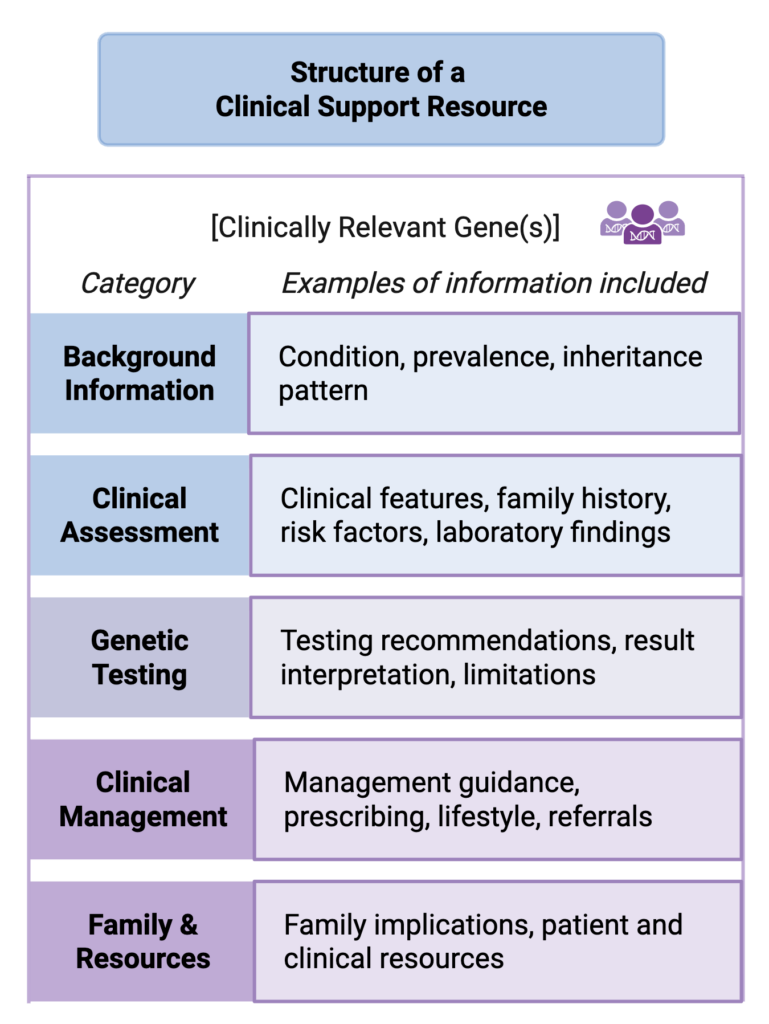
Building these guides gave participants practice applying genetics to patient care and a consistent way to evaluate genetic conditions. After training ended, participants could still use similar quick-reference guides and consult genetic counselors as questions came up.
Does Training Alone Make Doctors Feel Ready?
Passing an exam is an important step, but true clinical confidence develops through repeated practice and ongoing support over time. At the end of the program, the healthcare professionals averaged 84.6% on a 25-question exam and scored well in a practice visit with a simulated patient. They rated the hands-on activities as the most valuable part of the program.
Six months later, participants reported feeling more prepared for some aspects of genomics-informed care than others. For example, 76% felt prepared to take a family health history, while 32% felt prepared to address genetic test results across a range of conditions. This variation reinforced an important lesson from the program: education can build foundational knowledge and skills, but primary care professionals also need ongoing resources and access to genetics expertise as they encounter different clinical situations.
With every study, there are limitations: the program had no comparison group, not every participant completed follow-up and follow-up lasted six months, so results may not apply to every setting.
What Helps Doctors Use Genetics in Everyday Care?
Following participants over time showed us that education is only one piece. Based on that experience, we developed a three-part framework.
- Foundational education: Practical, case-based training rooted in real primary care situations.
- Point-of-care tools: Condition-specific guides healthcare professionals can check during a visit, covering testing, management and family implications.
- Genetics expertise: Access to genetic counselors and referral pathways for complex cases.
Elements like self-paced learning, digital support tools and virtual access to genetic counselors can help this approach work across many kinds of primary care settings. The objective isn’t to replace specialists, but to foster collaborative care that benefits both patients and healthcare professionals.
What Does This Mean for You?
For healthcare professionals and health systems, our experience suggests that genetics belongs in primary care, and that the right mix of training, tools and expert support can help make it work.
For individuals, if you have genetic test results you would like to explore, your primary care doctor or nurse practitioner is a great place to start the conversation. Bring your results and what you know about your family health history, and ask whether a genetic counselor could help with anything complex. And to learn more about how genetics works and what your DNA can tell you, explore the 23andMe Genetics Learning Hub.
About the Authors
Anne Greb, M.S., CGC — Director of Health Education
Anne Greb leads initiatives that translate genomic science into educational resources for broad audiences. She holds a Master of Science in Medical Genetics from the University of Wisconsin–Madison and is board certified in genetic counseling. Anne is a former President of the American Board of Genetic Counseling and previously served as the founding director of the Genetic Counseling Graduate Program at Wayne State University School of Medicine, and director of the Joan H. Marks Graduate Program in Human Genetics at Sarah Lawrence College. An expert in genetics literacy, Anne has contributed to scholarship and professional education in genomics, including authorship of a chapter on direct-to-consumer genetic testing in The Oxford Handbook of Genetic Counseling.
Noura Abul-Husn, M.D., Ph.D. — Chief Medical Officer
Dr. Noura Abul-Husn is the Chief Medical Officer of the 23andMe Research Institute, she also serves as an Associate Professor of Medicine at the Icahn School of Medicine at Mount Sinai. She is a physician scientist double board-certified in Internal Medicine and Medical Genetics and an expert in personalized healthcare and genomic medicine. Prior to joining 23andMe, Noura served as the founding Chief of the Division of Genomic Medicine and Clinical Director of the Institute for Genomic Health at Mount Sinai, where she led multidisciplinary teams advancing genomic research, education and care delivery. . She has published extensively on genomic discovery, genomic medicine and health equity. As a leader in genomic medicine, Noura is a go-to resource for clinical strategy, implementation of genomics in healthcare and advancing genetics-informed care for all.


